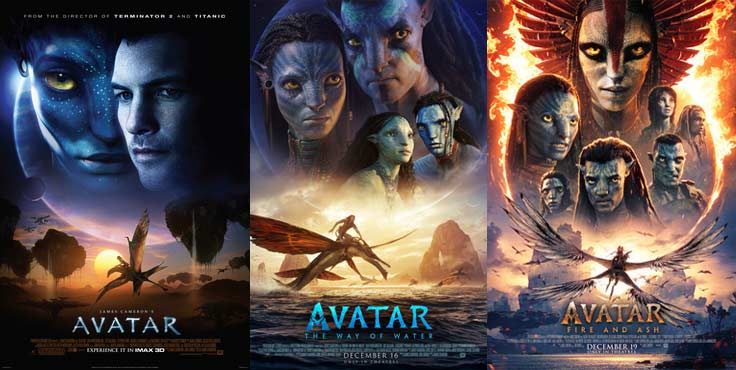
 Image: Avatar trilogy (Wikipedia)
Avatar 1 & 2 & 3: How World-Building, Biology, and Design Evolved
When the first Avatar landed in 2009 it felt like a new rulebook for cinematic worlds: lush, tactile, and convincingly alive. The sequels didn't just amplify scale and spectacle—they deepened the ecological logic and cultural complexity of the Na'vi and Pandora. Together, Avatar 1, 2, and 3 form a case study in how consistent world-building, believable biology, and disciplined visual design produce emotional resonance. This post breaks down the trilogy through a concept-artist's lens and shows practical lessons you can apply to your own world-building.
Act I — Establishing a Living World (Avatar 1)
Avatar 1 introduced a baseline principle: design that obeys constraints reads as real. Cameron's team layered sensory detail—plant movement, tentacular textures, and integrated symbioses—on top of dramatic scale. Two practical takeaways for artists:
- Start with environmental constraints: light quality, gravity, and available nutrients determine plausible morphologies.
- Add micro-behaviors: small, repeated motions (pulsing leaves, breathing undergrowth) sell macro scale.
The film’s most successful moments are not the spectacle shots but the interactions where organismal design and behavior feel functionally motivated: the ikran (banshee) bond ritual uses recognizable animal cues (pairing behavior, territorial displays) so the viewer intuitively understands stakes without exposition.
Act II — Expanding Ecology and Culture (Avatar 2)
The sequels move from singular ecosystems to connected systems. Avatar 2 explores marine biomes, coral-like megaflora, and symbiotic technologies. Here the creative challenge is scale management: how do you design many believable systems that coexist?
Design lessons:
- Maintain functional roles: as new biomes appear, assign clear ecological niches—herbivores, filter feeders, ambush predators, decomposers.
- Reuse rules across contexts: reapplying the same evolutionary logic (e.g., bioluminescence for signaling) across land and sea creates cognitive coherence.
From a concept perspective, the sequel's success comes from cascading design choices. Choose a core rule (e.g., dense underwater light scattering) and let it influence coloration, body shape, and behavior. This ripple effect keeps the expanded world feeling like one organismal system rather than a series of disconnected set pieces.
Act III — Integrating Technology, Myth, and Evolution (Avatar 3)
The third installment weaves culture and technology deeper into biological logic. Tools and rituals are rooted in environmental affordances—binding tech to anatomy or using local materials with obvious physical advantages. Concept artists should note how the film avoids deus ex machina: new capabilities are introduced with explanatory constraints that make them plausible.
Key approaches:
- Rationalize culture through ecology: a people's rituals or technologies should arise from how they survive and move in their environment.
- Ground fantastical tech in materials science: if a device floats, show what counters gravity or reduces mass.
In practice, this means annotating designs with 'why' statements: why would a tribe develop a particular weapon, mount, or garment? The answers make costume and prop design feel culturally embedded and narratively truthful.
Visual Evolution Across the Trilogy
Across the three films you can trace an evolution from single-biome wonder to systemic ecology. Visual language matures: silhouettes become more readable, palettes reflect biome-specific light physics, and motifs repeat in culturally meaningful ways. For concept artists, this suggests a workflow:
- Define a visual motif and use it as a design seed across species, architecture, and artifacts.
- Use silhouette tests early to ensure readability at scale.
- Develop a color-system tied to environmental light, not arbitrary mood—this strengthens immersion.
When motifs carry meaning (a recurring stripe, a shell pattern), the world accumulates cultural history without extra exposition.
Speculative Biology: The Trilogy’s Secret Weapon
What makes Pandora feel like a functioning world is not just pretty imagination but speculative biology—the disciplined inference of how life might adapt under different physical constraints. Cameron’s team borrowed from Earth’s evolutionary logic: convergent features, tradeoffs, and energy flows.
For practical application:
- Build simple food webs first. Who eats whom? Where does energy enter the system?
- Ask lifecycle questions: how do organisms reproduce? What are juvenile vs. adult roles?
- Sketch anatomical justifications: flippers, frills, and bioluminescent organs should solve problems, not decorate them.
These choices produce a network of implications that make every creature feel like a product of its world.
Production Design as Narrative Engine
Props and architecture in the trilogy do more than look attractive—they reveal relationships between Na'vi culture and Pandora. Materials, joinery, and ornamentation are informed by available resources and survival strategies. When objects embody constraints, they communicate story efficiently.
Tips for designers:
- Annotate props with supply chains: what materials, tools, and time investments produced this object?
- Let making processes show in design: signs of repair, patching, and reuse add historical depth.
These details reward careful viewers and give actors tactile anchors for authentic performance.
Lessons for Your Own Worlds
Whether you’re designing alien oceans or a post-apocalyptic city, apply the trilogy’s discipline:
- Begin with physics and energy, not aesthetics.
- Let ecological roles shape morphology and behavior.
- Repeat motifs across culture and biology to build unifying visual grammar.
- Annotate your designs with functional explanations to prevent arbitrary choices.
If you adopt these constraints, your creations will feel like discoveries instead of inventions.
Skill Sidebar
- Environmental Color Systems: Build palettes based on light scattering and atmosphere.
- Silhouette and Thumbnailing: Rapidly iterate readable shapes that communicate function.
- Speculative Biology Mapping: Create food webs and lifecycle diagrams to ground creature design.
The Avatar trilogy is a masterclass in scaling believable design from a single organism to a global biosphere. Its biggest takeaway for concept artists is procedural: when every creative choice is accountable to an ecosystem, the world becomes inevitable—and viewers believe it.