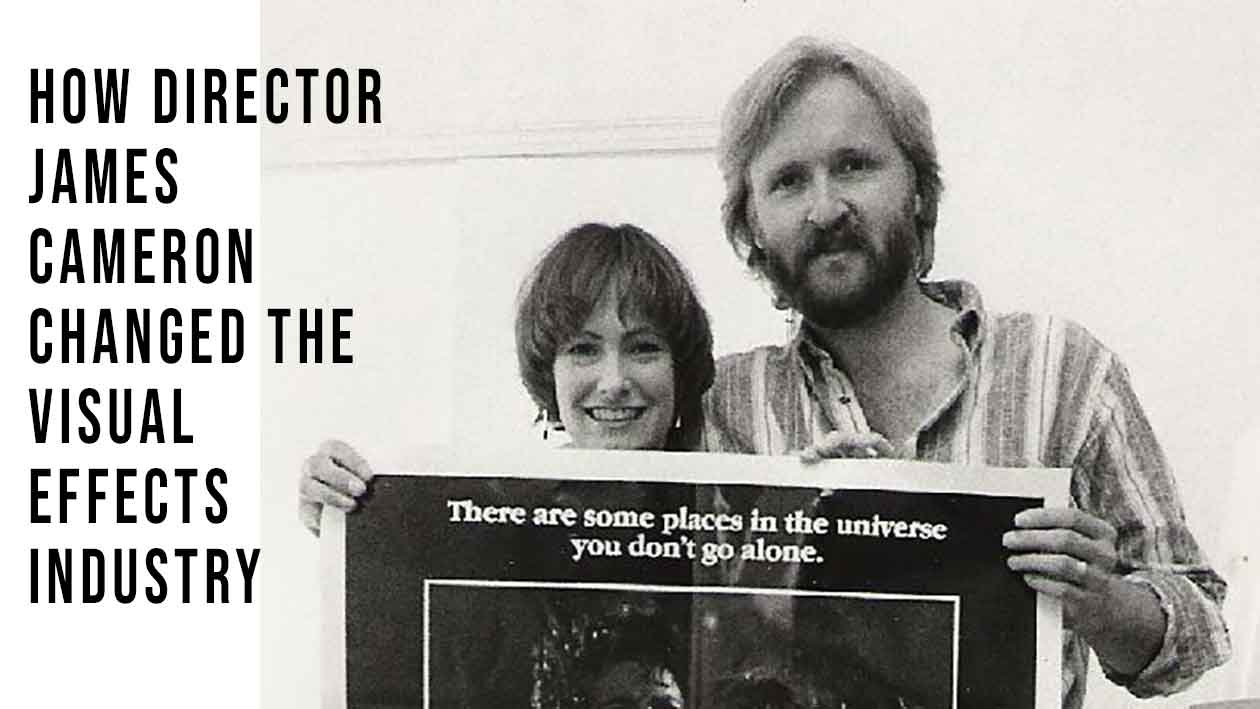
Image: Cameron with Gale Anne Hurd, 1986, holding a movie poster together. Photo by Towpilot - Own work, CC BY-SA 3.0, (Wikipedia)
How Director James Cameron Changed the Visual Effects Industry
James Cameron is best known as a storyteller, but his career reads as a continuous series of interventions that expanded what visual effects (VFX) could do—and how the industry organizes itself to deliver those effects. From the fluid pseudopod of The Abyss to the photoreal digital doubles of Terminator 2 and the immersive performance-capture systems of Avatar, Cameron has repeatedly pushed production pipelines, hardware, and creative workflows. This post traces those moves, explains their technical and cultural impact, and distills practical lessons for creators and teams working with VFX today.
Early Proofs: Practical Effects Meet Digital Thinking
Cameron’s early films show a pragmatic appetite for problem-solving. In The Abyss (1989) the breakthrough wasn’t just a striking shot of a water-formed pseudopod—it was a commitment to solve a storytelling need by inventing new digital tools and integrating them with live-action photography. That film and Terminator 2 (1991) proved that visual effects could be more than spectacle: they could carry emotion and narrative beats.
Key impacts:
- The industry saw the value of task-driven R&D—build tools to solve real editorial needs, not as tech for its own sake.
- Grounding digital elements in real-world references (lighting, weight, interaction) became a standard.
Those lessons changed how VFX houses approached shots: matchmove and compositing became story-driven crafts rather than isolated technical chores.
Building Pipelines and Partnerships
Cameron’s projects are notable for the partnerships he forms with VFX houses and technologists. He consistently invests in bespoke pipelines—custom tools for rendering, simulation, or capture—rather than shoehorning work into off-the-shelf solutions. That approach had two industry-wide consequences:
- It incentivized studios to build deeper engineering teams, spawning long-term research groups within vendors.
- It normalized longer preproduction and postproduction windows where pipelines could be developed and optimized.
The upshot: the modern VFX studio is as much a software engineering organization as an art shop, with dedicated R&D spending, versioned tools, and cross-disciplinary collaboration.
From Practical to Photoreal: Raising the Bar
Cameron’s insistence on photorealism forced the industry to measure success differently. Where earlier effects were forgiven as “stylized,” films like Terminator 2 demanded believable reflections, accurate subsurface scattering, and motion that obeyed physical constraints. Pushing these details required improvements across the stack—modeling fidelity, shader development, lighting workflows, and render farm scaling.
Consequences for the industry:
- Higher fidelity became expected, not exceptional—audiences would quickly notice shallow approximations.
- Toolchains fragmented into specialized stages (hair, skin, fluids), each requiring domain expertise.
This specialization increased costs but also created new roles and career paths in VFX: lighter-weight generalists gave way to specialists in simulation, look development, and performance capture.
Performance Capture and Virtual Production: The Avatar Turning Point
Avatar (2009) represents a pivot from purely post-production digital effects to an integrated production methodology where capture, virtual cameras, and realtime viewing converge. Cameron championed performance-capture that preserved actor nuance and an on-set virtual camera system that let directors compose shots in 3D space while actors performed.
Why that matters:
- It reduced the creative distance between the director, performers, and digital world—decisions could be made earlier and with more confidence.
- It demanded real-time visualization systems and dense data-management practices, accelerating investment in GPUs, realtime engines, and networked storage.
Practically, this shift influenced the entire industry toward “virtual production” workflows now common on major shoots: LED volumes, live previs, and director-facing tools that reveal final-look lighting and framing during performance.
Exhibition and Immersion: Stereoscopic 3D and Beyond
Cameron also changed how films are presented. By advocating for high-quality native stereoscopic capture and projection, he demonstrated that 3D could be more than a gimmick—when done intentionally, it serves composition and storytelling. He similarly pushed exhibition standards: higher bitrates, calibrated projection, and tighter QC for 3D screenings.
The effect on the market:
- Theaters upgraded hardware, studios adjusted distribution specs, and vendors created new formats and pipelines for stereo mastering.
- Audiences began to expect immersive presentation options for tentpole films, influencing release strategies and ancillary revenue.
Industrial Scale: Long-Term Economic Effects
Cameron’s projects are expensive and long-lead, but they altered expectations about investment in R&D and human capital. Studios began to fund longer schedules and larger render farms, and VFX vendors expanded geographically and organizationally to meet scale demands.
Industry outcomes:
- Growth of specialist vendors and regional hubs capable of large pipeline work.
- More formalized training programs and the professionalization of VFX education—schools and studios started producing engineers and artists to meet demand.
These changes reduced the costs of some effects over time (better tools, commodity hardware) while raising baseline expectations for what “good” looks like.
Criticisms and Healthy Constraints
It’s worth noting that Cameron’s approach also introduced tensions: ballooning budgets, studio risk aversion to unproven narrative ideas, and a perception that spectacle could mask weaker storytelling. The industry learned a counter-lesson as well: technology must be disciplined by story. Cameron’s most successful moments marry technical ambition with clear dramatic purpose.
Lessons for Creators and Teams
Whether you’re a solo artist or leading a VFX team, Cameron’s career suggests practical habits:
- Drive tool development from editorial needs—start with the shot or beat you need to sell.
- Invest in realtime visualization early to shorten feedback loops between director, cinematographer, and VFX.
- Annotate creative choices with functional rationale: why a system behaves a certain way, or why a shot requires that simulation.
- Prioritize readable composition and physical plausibility; photoreal detail without narrative clarity is wasted effort.
Skill Sidebar
- Previsualization: Learn to build cheap, fast previs that inform tool and rig design.
- Performance Capture Pipelines: Understand data flow from capture to animation cleanup and retargeting.
- Look Development: Master physically based shading and scene scale to achieve believable renders.
Conclusion
James Cameron’s influence on VFX is not a single invention but a pattern: identify a storytelling need, fund the technical work to meet it, and integrate that tech into the production process. The result has been higher expectations, more sophisticated pipelines, and an industry that mixes artistry with engineering. For creators, the takeaway is simple and powerful—let storytelling lead technical innovation, and build tools that answer editorial questions. That is how effects stop being decoration and become part of the narrative muscle of cinema.